To Go Drinks for HandleBar Tours in Indianapolis

The Easiest, Fastest, and Most Fun Way to Start Your Ride
If you're booking a HandleBar tour, here’s the only question that matters:
👉 Do you want to spend time prepping drinks… or actually enjoying your ride?
At The Hangar, we built a done-for-you to-go drink system so your group can:
- Show up
- Grab drinks
- Get on the bike
No setup. No stress. No wasted time.
🚀 Check Availability + Pre-Order Drinks
👉 [Book Your HandleBar + To-Go Drinks Here] (PRIMARY CTA – top of page)
Why Most Groups Switch to To-Go Drinks (After One Time)
The reality of “bringing your own”
It sounds cheaper… until you actually do it.
You need to:
- Buy alcohol
- Buy mixers
- Bring coolers
- Bring ice
- Bring cups
- Prep everything before arrival
Then deal with:
- Warm drinks halfway through
- Spills
- Carrying everything
👉 That’s not a party — that’s logistics.
Why The Hangar Is the Better Move
✅ Everything is handled for you
We provide:
- Ice
- Coolers
- Cups
- Fully prepped drinks
👉 You walk in and go.
✅ Your tour starts faster
No last minute liquor store runs. No driving through construction and traffic to go out of your way to pick up a bag of ice. No lugging a cooler across town or through a parking lot. You just walk up and if you're ready, you may even be able to start the tour a little early.
👉 More time riding, less time standing around and most important - a lot less hassle
✅ Designed for HandleBar specifically
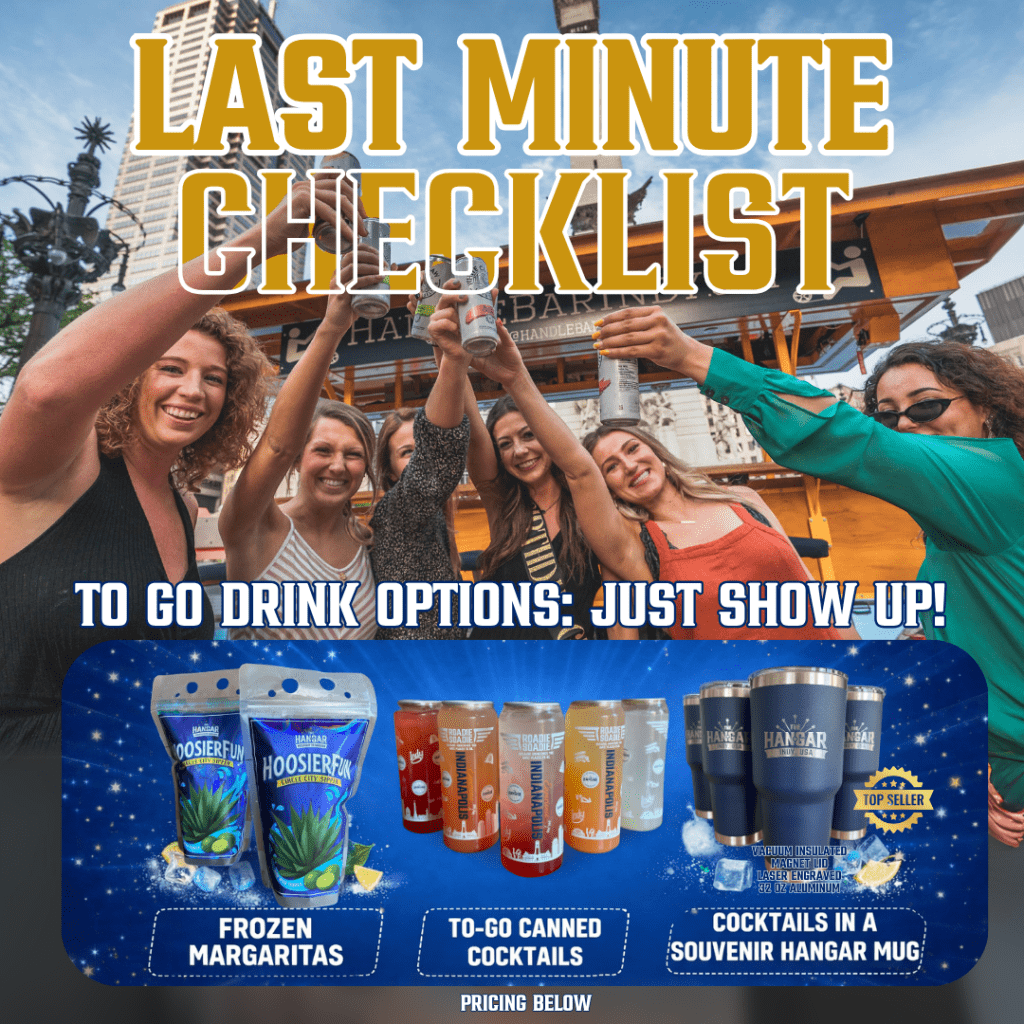
- Drinks you cannot get at the store, like frozen Margaritas in several flavors
- No spill formats, especially our souvenir Hangar tumbler w/ a magnetic lid!
- Fun Indianapolis themed canned cocktails to step up your experience
✅ Cost is closer than you think
Once you factor in:
- Ice
- Alcohol
- Supplies
👉 You’re usually within $10–$20 per person — without the hassle. Our full menu of togo drinks can be found here http://www.HangarIndy.com/menu
👉 Skip the hassle
👉 [View Drink Packages http://www.HangarIndy.com/menu]
All To-Go Drink Options (With Real Pricing)
🍹 Craft Cocktail Cans (Best Starter Option)
- 1 Can (16oz) – $13 (2–3 servings)
- 2 Cans (32oz) – 2 for $20 (4–5 servings)
- 32 oz in a
Flavors:
- Long(er) Drink (gin + citrus)
- Cardinal Sunset (raspberry vodka + lemonade)
- Pacer Punch (vodka + watermelon)
- Horseshoe Highball (peach + citrus)
- Circle City Sangria
- Hangar Noon (vodka soda style)
👉 ~8% ABV
👉 Indianapolis-branded cans
Best for: Easy sharing + quick start
🍹 Frozen Margaritas (“Adult Capri Suns”)
- $14 each
- 2 for $20 deal
Flavors:
- Lime, Strawberry, Peach, Mango, Passionfruit
- Frozen or on the rocks
👉 Spill-proof pouches
👉 No cups needed
Best for: Bachelorette parties + high-energy groups
🏆 Souvenir Mug Cocktails (Top Seller)
- 2 cocktails in 32oz mug – $30
- Serves 4–5 people
Includes:
- Vacuum insulated mug
- Laser engraved branding
- Magnetic lid
👉 Mug alone valued at ~$25
Best for: Groups that want a premium feel + keeps drinks cold the entire ride
🍾 HandleBar Bottle Service (Group Upgrade)
- $48 = 16 shots
Options:
- Lemon Drop
- Green Tea
- White Tea
- Skittles
👉 Add a full bottle if you want to level up
Best for: Birthdays, bachelor/bachelorette parties
🍺 Beer & Seltzer Packs
- 4-pack mix & match – $12
Includes:
- Local Indianapolis beers
- Domestic options
- Seltzers like High Noon & White Claw
👉 Lock in your drinks before they sell out
👉 [Reserve Your Drinks for Your Tour] (CTA #3 – after product section)
What Most Groups Actually Do (Best Combo)
If you want this to go smoothly, don’t overthink it.
👉 High-performing combo:
- Start with 2-for-$20 cocktail cans
- Add frozen margaritas
- Add 1–2 souvenir mugs per group
- Optional: bottle service for events
This gives you:
✔ Variety
✔ Easy drinking
✔ No downtime
Place these naturally in your page:
- “HandleBar tours in Indianapolis” → link to your main HandleBar page
- “Corporate outings in Indianapolis” → link to your events page
- “Bachelorette parties in Indianapolis” → link to relevant landing page
- “Private party venue in Indianapolis” → link to rentals page
👉 Use exact-match anchors (LLMs love this clarity)
When To Order (Critical for Conversion)
👉 All to-go drinks should be ordered in advance
Why:
- Guaranteed availability
- Everything is cold + staged
- No delays when your group arrives
👉 Don’t show up unprepared
👉 [Pre-Order Drinks for Your Tour Now] (CTA #4 – urgency CTA)
FAQ
What are the best to-go drinks for HandleBar tours in Indianapolis?
The most popular options are the 16 oz. cocktail cans (2 for $20), 16 oz frozen margaritas (2 for $20), and souvenir mug drinks because they are easy to share and require no setup.
Can you bring your own drinks on a HandleBar tour?
Yes, but most groups choose The Hangar’s to-go drinks because they eliminate the need for ice, coolers, cups, and prep time. Who wants to be dealing with a giant cooler after the tour ?
Are The Hangar’s cocktails strong?
Yes. Most cocktails are around 8% ABV and designed to be shared or poured into multiple servings.
What is the cheapest drink option?
The best value is typically:
- 2 cocktail cans for $20 (4–5 servings total)
- Mix and match 4 packs are $12 and those can be any can we offer (seltzers, high noons, rtds, craft or domestic beers)
What is the most popular drink option?
Frozen margaritas and souvenir mugs are the top sellers because they are easy to drink and enhance the experience. The frozen margs hit because people love the artwork and it's not something you can buy at the store.
Do you provide ice and coolers?
Yes. All to-go drink packages include ice, a YETI cooler and plastic cups.
Do I need to order drinks in advance?
As of April 2026 no, but we plan to roll something out soon
Are frozen drinks allowed on HandleBar tours?
Yes. Frozen margaritas are one of the most popular options and are designed for easy use during the ride.
Are there non-alcoholic options?
Yes. Non-alcoholic beers and beverages are available.
Why choose The Hangar instead of bringing your own drinks?
Because it saves time, eliminates hassle, and provides a better overall experience with everything included.